
Skin Cancer Screening: What to Expect During a Dermatology Exam
- posted: Mar. 04, 2026
Early detection is the most effective defense against skin cancer. While monthly self-exams at home are important for noticing changes, a professional screening by a dermatologist provides a level of scrutiny that is impossible to achieve alone. At the Dermatology Center of Southern Indiana, our providers in Bloomington, Bedford, and New Whiteland are trained to identify subtle irregularities in moles and lesions that may indicate the early stages of basal cell carcinoma, squamous cell carcinoma, or melanoma. A routine exam is quick, non-invasive, and can be life-saving.
Preparing for Your Skin Cancer Screening
To ensure the most thorough exam, there are a few simple ways to prepare. We recommend removing all nail polish from your fingernails and toenails, as skin cancer can sometimes develop in the nail bed. It is also best to wear your hair loose so the scalp can be easily inspected. Avoid wearing heavy makeup or tinted moisturizers on the day of your appointment. When you arrive at our office, you will be asked to change into a medical gown, allowing your provider to view your skin from head to toe in a private and professional setting.
A Systematic Head-to-Toe Inspection
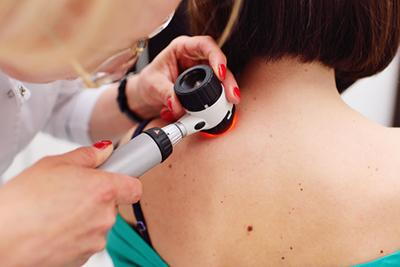
During the exam, your dermatologist will systematically check your entire body. This includes often-overlooked areas such as the scalp, behind the ears, the soles of the feet, and between the toes. We use a specialized tool called a dermatoscope, a handheld device that combines high-magnification lenses with polarized light. This allows us to see deep into the structures of a mole to determine if the pigment pattern is healthy or suspicious. If you have a specific spot that has been itching, bleeding, or changing shape, this is the time to point it out to your provider.
What Happens if a Suspicious Spot is Found?
If your doctor discovers a lesion that shows characteristics of skin cancer, the next step is typically a skin biopsy. This is a simple procedure performed right in our office using local anesthesia. A small sample of the tissue is removed and sent to a laboratory for microscopic analysis by a pathologist. It is important to remember that not every biopsy results in a cancer diagnosis; many times, we remove atypical moles to prevent them from becoming a problem in the future. We will contact you with the results as soon as they are available to discuss any necessary follow-up care.
Building a Lifetime of Skin Health
An annual skin exam is a vital component of your overall healthcare routine, especially for residents of Southern Indiana who spend significant time outdoors. Whether you have a history of sun damage or simply want peace of mind, our team is here to support you. We encourage patients of all skin types to schedule a baseline screening to establish a record of their moles and markings. Contact the Dermatology Center of Southern Indiana today at our Bloomington, Bedford, or New Whiteland, IN, location to schedule your appointment. Call 812-339-6434.
- posted: Mar. 04, 2026
Early detection is the most effective defense against skin cancer. While monthly self-exams at home are important for noticing changes, a professional screening by a dermatologist provides a level of scrutiny that is impossible to achieve alone. At the Dermatology Center of Southern Indiana, our providers in Bloomington, Bedford, and New Whiteland are trained to identify subtle irregularities in moles and lesions that may indicate the early stages of basal cell carcinoma, squamous cell carcinoma, or melanoma. A routine exam is quick, non-invasive, and can be life-saving.
Preparing for Your Skin Cancer Screening
To ensure the most thorough exam, there are a few simple ways to prepare. We recommend removing all nail polish from your fingernails and toenails, as skin cancer can sometimes develop in the nail bed. It is also best to wear your hair loose so the scalp can be easily inspected. Avoid wearing heavy makeup or tinted moisturizers on the day of your appointment. When you arrive at our office, you will be asked to change into a medical gown, allowing your provider to view your skin from head to toe in a private and professional setting.
A Systematic Head-to-Toe Inspection
During the exam, your dermatologist will systematically check your entire body. This includes often-overlooked areas such as the scalp, behind the ears, the soles of the feet, and between the toes. We use a specialized tool called a dermatoscope, a handheld device that combines high-magnification lenses with polarized light. This allows us to see deep into the structures of a mole to determine if the pigment pattern is healthy or suspicious. If you have a specific spot that has been itching, bleeding, or changing shape, this is the time to point it out to your provider.
What Happens if a Suspicious Spot is Found?
If your doctor discovers a lesion that shows characteristics of skin cancer, the next step is typically a skin biopsy. This is a simple procedure performed right in our office using local anesthesia. A small sample of the tissue is removed and sent to a laboratory for microscopic analysis by a pathologist. It is important to remember that not every biopsy results in a cancer diagnosis; many times, we remove atypical moles to prevent them from becoming a problem in the future. We will contact you with the results as soon as they are available to discuss any necessary follow-up care.
Building a Lifetime of Skin Health
An annual skin exam is a vital component of your overall healthcare routine, especially for residents of Southern Indiana who spend significant time outdoors. Whether you have a history of sun damage or simply want peace of mind, our team is here to support you. We encourage patients of all skin types to schedule a baseline screening to establish a record of their moles and markings. Contact the Dermatology Center of Southern Indiana today at our Bloomington, Bedford, or New Whiteland, IN, location to schedule your appointment. Call 812-339-6434.
