
Recognizing the Early Warning Signs of Skin Cancer
- posted: Jun. 17, 2025
Skin cancer is common, and early detection plays a crucial role in successful treatment. When identified at an early stage, most skin cancers can be treated effectively, often with minimal impact on surrounding tissue. Understanding what to look for on your skin and when to seek professional evaluation can make a significant difference in outcomes, so the team at the Dermatology Center of Southern Indiana, with offices in Bloomington, Bedford, and New Whiteland, Indiana, wants to help you know the signs of skin cancer.
Changes That Should Not Be Ignored
The first step in recognizing skin cancer is becoming familiar with your skin. New growths, changes in existing moles, or sores that don’t heal can all be early warning signs. Pay attention to moles that evolve in size, shape, or color. A mole that starts to itch, bleed, or crust over could indicate a bigger issue. It’s especially important to be aware of any lesion that looks noticeably different from the others on your skin, sometimes called the “ugly duckling” sign.
Types of Skin Cancer and Their Signs
Basal cell carcinoma often appears as a pearly bump, flat scar-like area, or a sore that repeatedly heals and reopens. Squamous cell carcinoma may look like a red, scaly patch, a firm bump, or a sore that crusts or bleeds. Melanoma, which is less common but more aggressive, typically shows up as an irregular, multicolored mole or dark lesion with uneven borders. Knowing these patterns can help you recognize when something might require medical attention.
Sun Exposure and Risk Awareness
Years of cumulative sun exposure increase your risk of developing skin cancer, especially if you’ve experienced frequent sunburns or used tanning beds. People with fair skin, light-colored eyes, or a family history of skin cancer are at higher risk. However, skin cancer can affect people of all skin tones, so routine skin checks are important for everyone.
When to See a Dermatologist
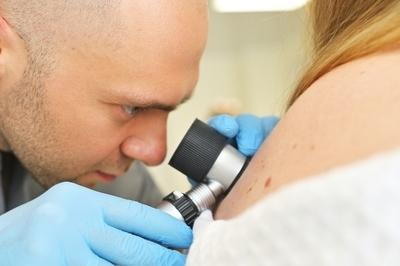
If you notice any suspicious changes on your skin, it’s wise to schedule an evaluation with a dermatologist. At the Dermatology Center of Southern Indiana, our Bloomington, Bedford, and New Whiteland, Indiana, teams provide thorough skin exams and biopsies when necessary to ensure an accurate diagnosis. We also emphasize education, helping patients understand what’s normal and what’s not when it comes to skin health.
Taking a Proactive Approach
Routine self-checks and annual skin exams can help catch skin cancer early. The earlier it’s found, the more treatment options are available, and the better the long-term results. If you’ve spotted a mole that’s changed, a sore that won’t heal, or a new lesion that concerns you, don’t wait to have it checked.
Partner with a Dermatologist for Your Skin Health
Skin cancer is highly treatable when caught early, and awareness is the first line of defense. The Dermatology Center of Southern Indiana will help you recognize early signs, answer your concerns, and provide expert care when you need it most. To schedule an appointment at our offices in Bloomington, Bedford, and New Whiteland, Indiana, call (812) 339-6434.
- posted: Jun. 17, 2025
Skin cancer is common, and early detection plays a crucial role in successful treatment. When identified at an early stage, most skin cancers can be treated effectively, often with minimal impact on surrounding tissue. Understanding what to look for on your skin and when to seek professional evaluation can make a significant difference in outcomes, so the team at the Dermatology Center of Southern Indiana, with offices in Bloomington, Bedford, and New Whiteland, Indiana, wants to help you know the signs of skin cancer.
Changes That Should Not Be Ignored
The first step in recognizing skin cancer is becoming familiar with your skin. New growths, changes in existing moles, or sores that don’t heal can all be early warning signs. Pay attention to moles that evolve in size, shape, or color. A mole that starts to itch, bleed, or crust over could indicate a bigger issue. It’s especially important to be aware of any lesion that looks noticeably different from the others on your skin, sometimes called the “ugly duckling” sign.
Types of Skin Cancer and Their Signs
Basal cell carcinoma often appears as a pearly bump, flat scar-like area, or a sore that repeatedly heals and reopens. Squamous cell carcinoma may look like a red, scaly patch, a firm bump, or a sore that crusts or bleeds. Melanoma, which is less common but more aggressive, typically shows up as an irregular, multicolored mole or dark lesion with uneven borders. Knowing these patterns can help you recognize when something might require medical attention.
Sun Exposure and Risk Awareness
Years of cumulative sun exposure increase your risk of developing skin cancer, especially if you’ve experienced frequent sunburns or used tanning beds. People with fair skin, light-colored eyes, or a family history of skin cancer are at higher risk. However, skin cancer can affect people of all skin tones, so routine skin checks are important for everyone.
When to See a Dermatologist
If you notice any suspicious changes on your skin, it’s wise to schedule an evaluation with a dermatologist. At the Dermatology Center of Southern Indiana, our Bloomington, Bedford, and New Whiteland, Indiana, teams provide thorough skin exams and biopsies when necessary to ensure an accurate diagnosis. We also emphasize education, helping patients understand what’s normal and what’s not when it comes to skin health.
Taking a Proactive Approach
Routine self-checks and annual skin exams can help catch skin cancer early. The earlier it’s found, the more treatment options are available, and the better the long-term results. If you’ve spotted a mole that’s changed, a sore that won’t heal, or a new lesion that concerns you, don’t wait to have it checked.
Partner with a Dermatologist for Your Skin Health
Skin cancer is highly treatable when caught early, and awareness is the first line of defense. The Dermatology Center of Southern Indiana will help you recognize early signs, answer your concerns, and provide expert care when you need it most. To schedule an appointment at our offices in Bloomington, Bedford, and New Whiteland, Indiana, call (812) 339-6434.
